
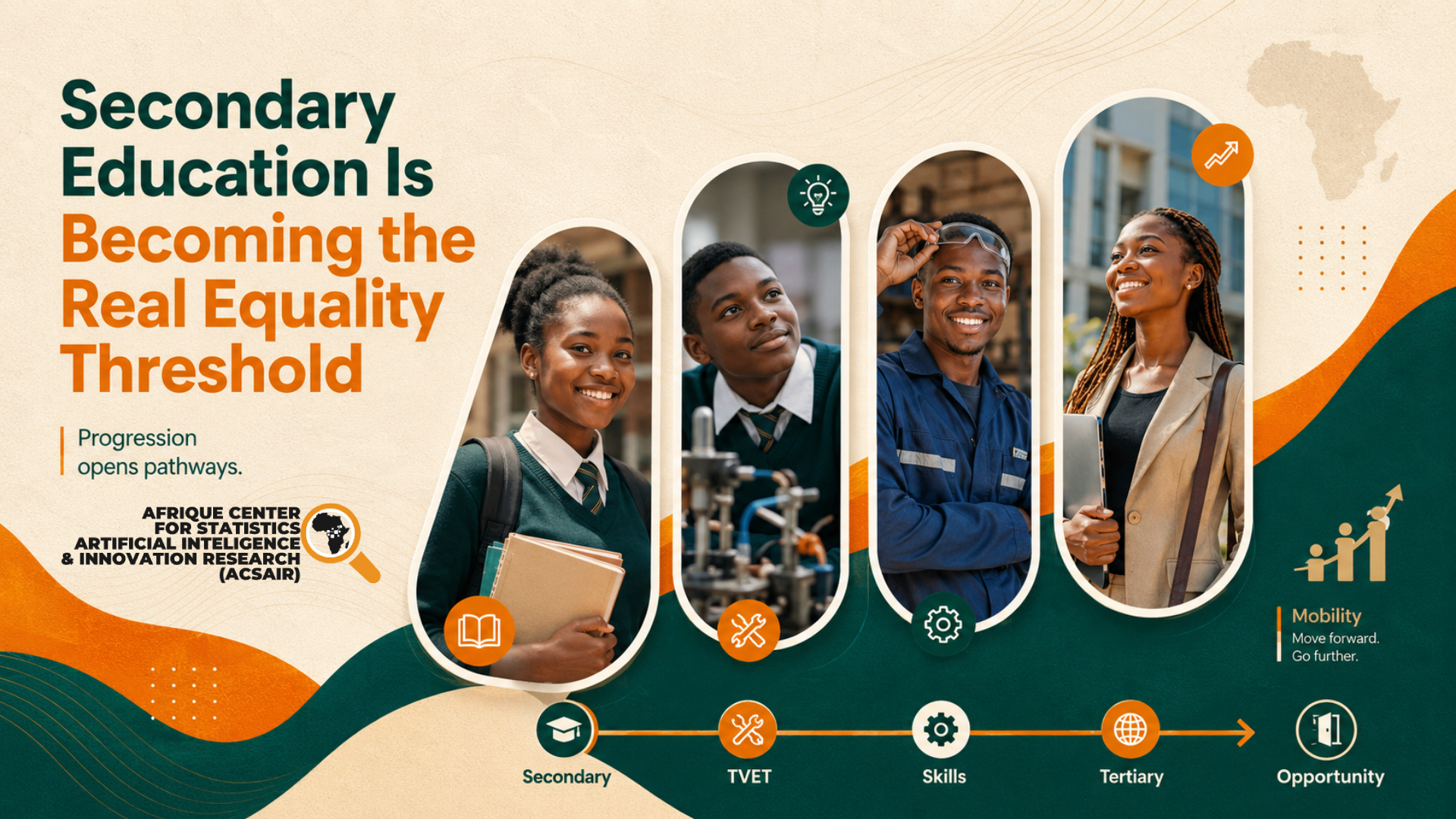
Primary education remains essential but the inequality conversation becomes sharper at secondary and tertiary levels. Primary school enrollment is relatively less sensitive to some household factors, while secondary school enrollment rises strongly with parental education and household wealth. This suggests that the transition beyond primary school is one of Africa’s most important equality thresholds.
This matters because the modern economy increasingly rewards higher levels of learning. Basic literacy and numeracy are foundational, but access to better jobs, technology-driven sectors, public administration, formal entrepreneurship and professional mobility often requires secondary education and beyond. When poorer children are less likely to cross this threshold, inequality becomes more durable.
Africa’s education agenda must therefore pay stronger attention to continuation. Completion of primary school should not become the end point for children from poorer households. The focus must include lower secondary, upper secondary, technical and vocational pathways, affordable tertiary access and practical links between learning and work.
The continent’s future workforce will be built by progression, completion, relevance and transition into opportunity. Secondary education is where many children either enter the pathway to mobility or begin to fall out of it and that makes it one of the most important battlegrounds for inclusive development.