
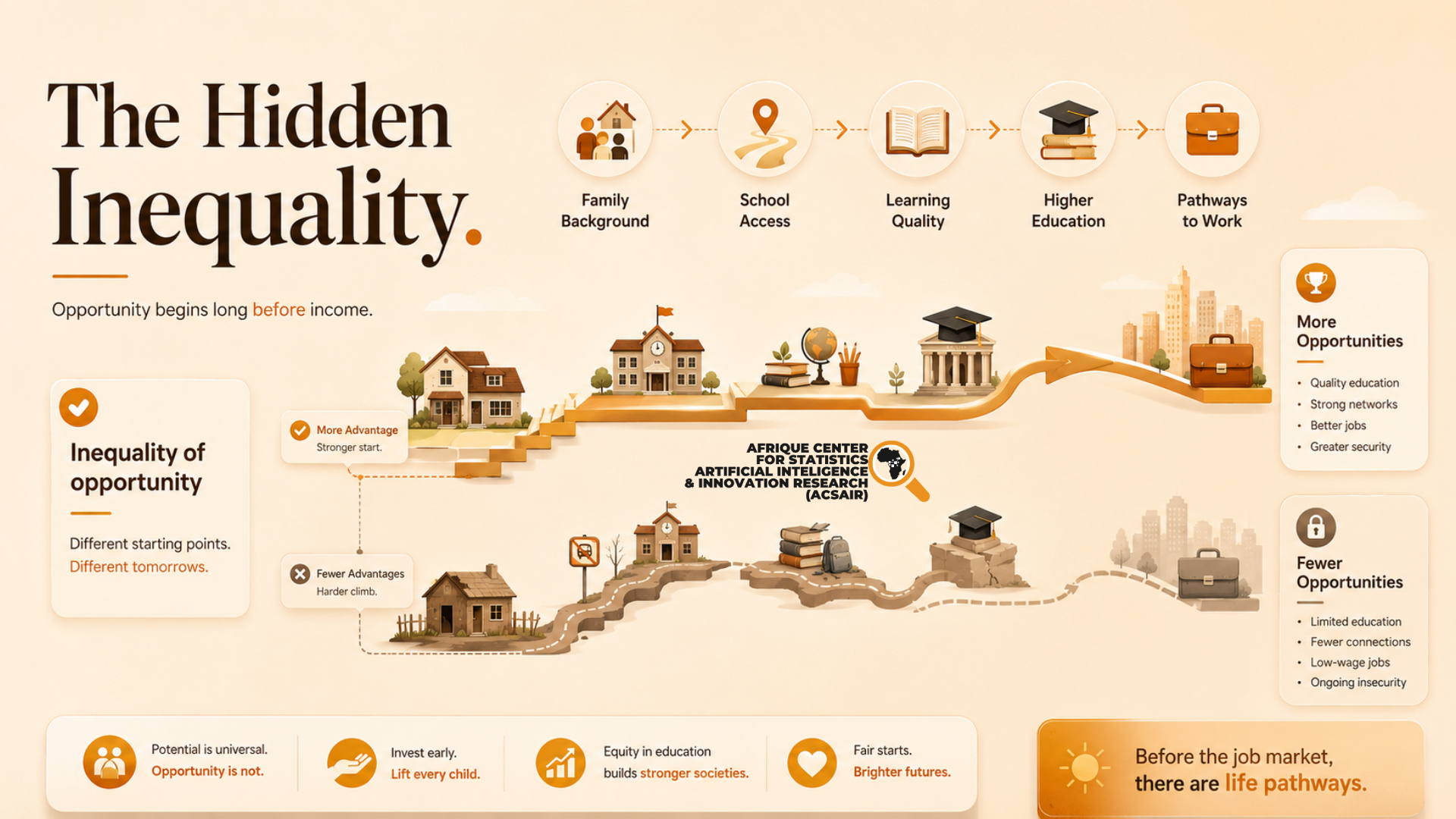
There is an ongoing public discussion on income inequality and this usually often begins after people enter the labour market. We compare wages, jobs, business opportunities, and access to capital yet a large part of inequality begins earlier, in the unequal conditions that shape who enters school, who remains there, who reaches higher levels and who later benefits from that education.
There is a difference between inequality of results and inequality of opportunity. Inequality of results is visible in income and wealth differences, while inequality of opportunity is rooted in circumstances such as parents’ education, household wealth, place of residence and family background. Inequality of opportunity is less visible, but it can shape life outcomes long before individual effort begins to matter.
When a child’s schooling depends strongly on parental wealth or education, the education system becomes part of the mechanism through which inequality is reproduced because the child may be talented, ambitious and capable, but the surrounding infrastructure of opportunity may already be uneven.
Africa’s inequality challenge must therefore be addressed before people reach the job market. It begins with early educational access, household support, school quality, safe learning environments, rural inclusion and pathways from school into meaningful work because a fairer economy begins when opportunity is made less dependent on inherited circumstances.