

Introduction
This report presents a comprehensive analysis of Algeria’s almond production data from 1961 through 2023. The dataset includes three key variables for almonds in shell: the area harvested in hectares, production quantity in tonnes and yield in kg per hectare. All charts referenced in this report were visualized by ACSAIR and are based on data sourced from Kaggle. The goal is to describe historical trends and changes in these variables without speculation, providing a factual account of how Algeria’s almond cultivation has evolved over the last six decades.
Area Harvested of Almonds in Algeria (ha)

Figure 1. Almond area harvested in hectares in Algeria, 1961 to 2023.
This line chart shows the total harvested area for almond crops each year. Note the sharp contraction in the late 1960s followed by long-term expansion into the 2000s, and a slight decline in the most recent years.
In 1961, Algeria harvested 13,300 ha of almond orchards. Over the next decade, the area under almonds decreased sharply, reaching an all-time low of 4,600 ha by 1971. This represents roughly a 65% contraction in cultivated area within ten years. The drop appears in Figure 1 as a steep downward slope in the late 1960s. After 1971, the trend reversed, and the almond growing area expanded steadily. Through the 1970s and 1980s, the area harvested rose from the 4,600 ha low to about 20,860 ha by 1986, returning to and then exceeding early 1960s levels. The expansion continued over the next two decades at a generally consistent pace. The harvested area peaked in 2010 at approximately 54,485 ha, the highest on record. This peak is about four times the area devoted to almonds in the early 1960s, highlighting a major long-term expansion of almond cultivation land.
After 2010, the data show a downward adjustment in almond area. From the 2010 high of 54,485 ha, the harvested area declined to about 40,000 to 42,000 ha in the mid-2010s. By 2020, the area had fallen further, reaching 32,492 ha in 2021, the lowest level in two decades. There was a modest uptick after 2021, with area harvested recovering to 38,544 ha by 2023. Despite this partial rebound, the 2023 area remains about 29% below the 2010 peak. Overall, the historical path for area harvested has a U-shaped pattern: a steep decline in the 1960s, a prolonged expansion from the 1970s to around 2010 and a recent contraction. These shifts in land under almonds have directly influenced production, as discussed next.
Almond Production in Algeria (tonnes)
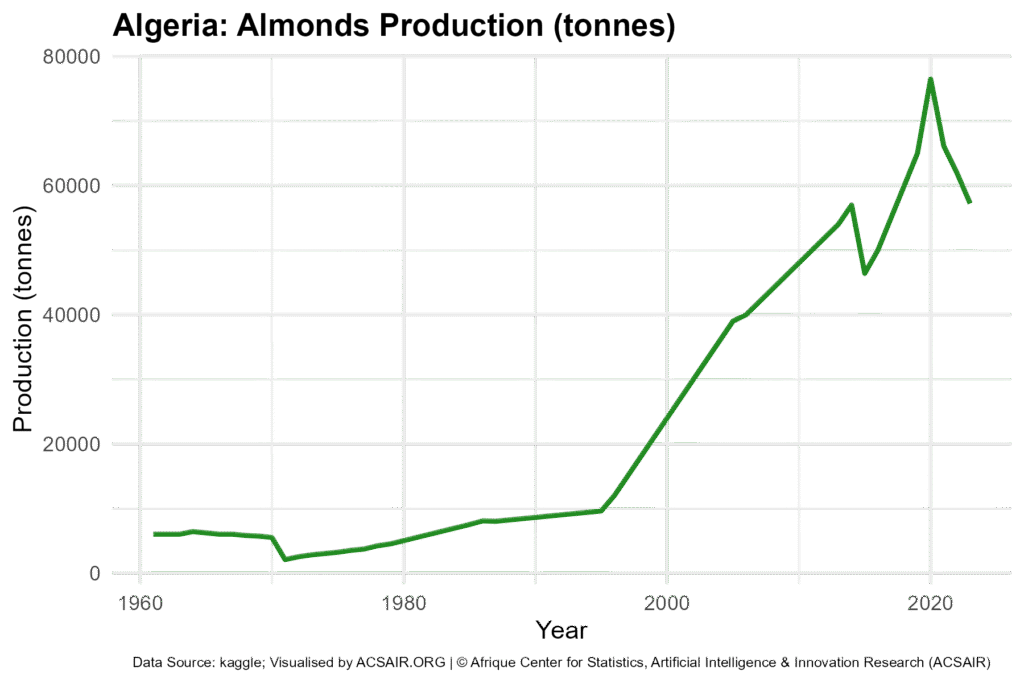
Figure 2. Algeria’s almond production in tonnes per year, 1961 to 2023, with a line trend similar in timing to the area chart but reflecting combined effects of area and yield.
Algeria’s almond production increased dramatically over the six-decade period, despite interim fluctuations. In 1961, almond production was approximately 6,000 tonnes. Production then declined alongside the shrinking harvested area during the 1960s, hitting a low of 2,070 tonnes in 1971. This was the smallest almond output on record, corresponding to the minimum area harvested in the same year. From the early 1970s onward, production began a steady rise. As more land returned to cultivation in the 1970s and 1980s, output recovered. By 1986, Algeria produced about 8,060 tonnes of almonds, returning to the production level of the early 1960s and surpassing it.
During the 1990s and 2000s, almond production continued to accelerate, reflecting both expanding orchard area and gradual yield improvements. By 2010, production reached 56,973 tonnes. Notably, the production curve steepened further in the early 2010s. Almond output peaked at 76,482 tonnes in 2015, which stands as the highest production year on record. This peak is over 12 times the output of 1971 and about 13 times the 1961 level, showing how dramatically production grew over the long term. The surge between the 1980s and 2015 appears as a strong upward slope in Figure 2 during that period.
After 2015, the production trend shows a moderate decline. Total output fell from the 2015 high to about 60,832 tonnes in 2020. In the final years of the series, production partially rebounded, with approximately 69,638 tonnes in 2023. This remains below the 2015 peak but is still very high historically. The post-2015 dip corresponds with the reduction in harvested area noted in Figure 1. Even though yields reached record highs in recent years, the loss of cultivated area after 2010 meant total output did not keep rising. Algeria’s almond production trend featured an initial drop in the 1960s, a tremendous multi-decade increase through about 2015 and a slight pullback in the last decade.
Almond Yield in Algeria (kg per ha)
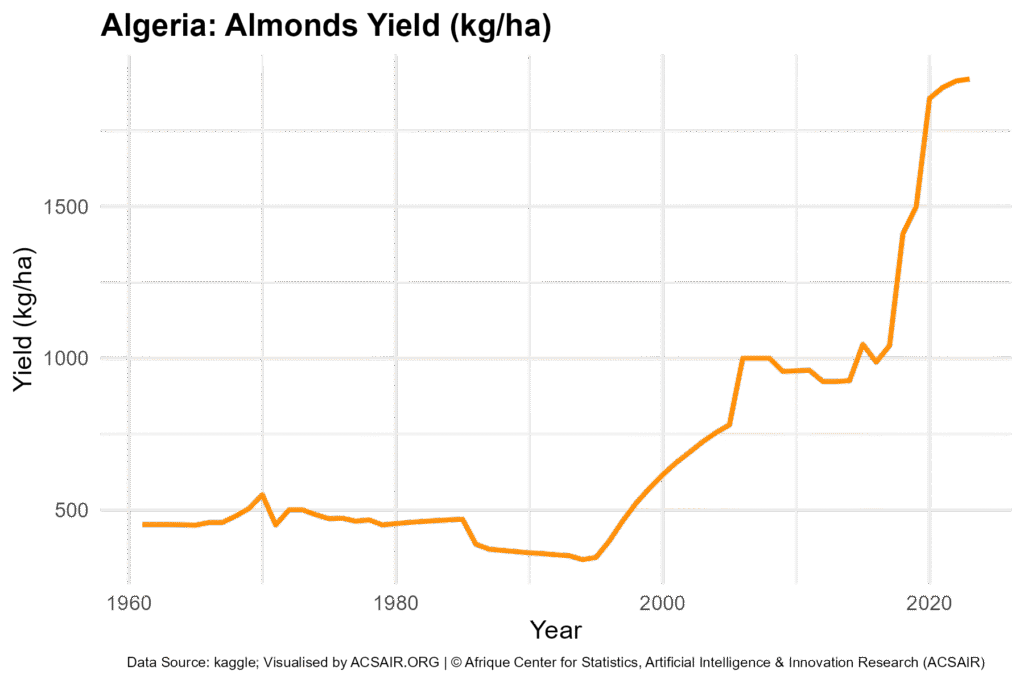
Figure 3. Trend in almond yield in kg per ha from 1961 to 2023, highlighting changes in productivity per unit of land.
Almond yield in Algeria, measured in kilograms per hectare, shows a different pattern from area and production, reflecting changes in agricultural productivity over time. In the 1960s, yields were relatively low but stable, around 450 kg/ha, which is 0.45 tonnes per ha. For example, from 1961 to 1965 the yield hovered near 450 to 451 kg/ha. Yields then declined during the 1970s and 1980s. By 1986, the average yield bottomed out at roughly 386.4 kg/ha, the lowest in the series. Throughout the late 1970s to mid-1980s, yields were in the 350 to 400 kg/ha range, indicating weaker productivity per hectare in that period, possibly due to less intensive practices or other challenges. This decline in yield compounded the drop in area, resulting in particularly low production in those years.
After the mid-1980s, yields clearly improved. From the late 1980s onward, yield rose, indicating increasing productivity of almond orchards. By 2000, yield had climbed to around 780 to 800 kg/ha, nearly double the levels of the 1980s. The upward trajectory continued and accelerated into the 21st century. In 2010, Algeria’s almond yield was about 1,045.7 kg/ha, approximately 1.05 tonnes per ha. By 2010, each hectare produced over twice as much output as a hectare did in the 1960s. Yield gains were even more pronounced in the 2010s: yield reached 1,893 kg/ha in 2015 and peaked at 2,046.7 kg/ha in 2019. The 2019 figure is the highest in the record, about 4.5 times greater than the yield in 1986. Such an increase suggests significant improvements in farming techniques, varieties or orchard management over time, allowing much more production per unit of land.
In the last few years, 2020 to 2023, yields fluctuated slightly but remained high. For instance, yield was about 1,806.7 kg/ha in 2023, a small drop from the 2019 peak but still roughly four times the mid-1980s level. The overall yield trend in Figure 3 can be summarized as relatively flat, around 450 kg/ha, in the 1960s, declining to a low in the 1980s, then a strong and sustained rise in productivity through the 1990s and 2000s, culminating in modern yields of about 1.7 to 2.0 tonnes per hectare in recent years.
Algeria’s almond sector underwent significant changes from 1961 to 2023. The harvested area experienced an initial collapse in the 1960s, followed by steady expansion that quadrupled the area by 2010, then a contraction in the 2010s. Total almond production grew enormously, roughly twelve-fold from the early 1970s low to the mid-2010s peak, driven by both the expansion of orchard area and notable improvements in yield per hectare. Almond yields improved marginally in the 1960s, fell in the 1970s to 80s and then increased sharply, reaching about four to five times their former levels by the late 2010s. The peak production year, 2015, reflected the largest area under cultivation combined with high yields. In recent years, production dipped below its peak because the reduction in area harvested outweighed continued high yields. Nevertheless, as of 2023 Algeria’s almond production remains very high by historical standards, supported by far greater orchard productivity than in past decades. This data-driven review by ACSAIR provides a factual account of trends in Algeria’s almond cultivation, highlighting dynamic changes in land use and agricultural productivity that have shaped the country’s almond output over time.